
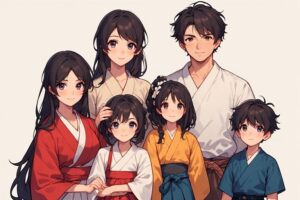
Talk about your family using simple Japanese sentences
Family is an important part of everyday conversation. When meeting someone, you may want to talk about your parents, brothers, sisters, or other family members. In this lesson, you will learn some essential Japanese family words and simple sentences that you can use to talk about your family.
Talking About Your Family
Let’s begin with a simple sentence.
私の家族です。
Watashi no kazoku desu.
This is my family.
The word 家族 (kazoku) means “family.”
You can also say:
私の家族です。
Watashi no kazoku desu.
My family.
The exact English translation can change slightly depending on the situation, but the Japanese expression remains simple and useful.
Essential Family Words
Here are some common family words for beginners.
Japanese | Transliteration | English |
家族 | kazoku | family |
父 | chichi | my father |
母 | haha | my mother |
兄 | ani | my older brother |
姉 | ane | my older sister |
弟 | otōto | my younger brother |
妹 | imōto | my younger sister |
夫 | otto | my husband |
妻 | tsuma | my wife |
子ども | kodomo | child / children |
息子 | musuko | son |
娘 | musume | daughter |
兄弟 | kyōdai | siblings / brothers and sisters |
When speaking about your own family, Japanese often uses different words from those used when referring politely to another person’s family. For now, focus on the basic vocabulary above.
How to Use the Word List
Let’s take one word and build a sentence.
母
Haha
My mother.
Now add 私の.
私の母
Watashi no haha
My mother.
Now add です.
私の母です。
Watashi no haha desu.
This is my mother.
You can use the same pattern with other family members.
私の父です。
Watashi no chichi desu.
This is my father.
私の兄です。
Watashi no ani desu.
This is my older brother.
私の妹です。
Watashi no imōto desu.
This is my younger sister.
Notice that the sentence pattern stays almost the same. You only change the family word.
Asking About Someone’s Family
You can ask a friend about their family.
家族は何人ですか。
Kazoku wa nan-nin desu ka.
How many people are in your family?
The important expression here is:
何人
nan-nin
How many people?
The counter 人 (nin) is used when counting people.
For example:
四人です。
Yon-nin desu.
There are four people.
五人です。
Go-nin desu.
There are five people.
Conversation Between Hokiru, Janet and Bob
Let’s see how Hokiru, Janet, and Bob can talk about their families.
ホキル:ジャネット、家族は何人ですか。
Janetto, kazoku wa nan-nin desu ka.
Hokiru: Janet, how many people are in your family?
ジャネット:四人です。
Yon-nin desu.
Janet: There are four people.
ホキル:お父さんとお母さんがいますか。
Otōsan to okāsan ga imasu ka.
Hokiru: Do you have a father and mother?
ジャネット:はい、います。
Hai, imasu.
Janet: Yes, I do.
ボブ:兄弟がいますか。
Kyōdai ga imasu ka.
Bob: Do you have any brothers or sisters?
ジャネット:はい、弟が一人います。
Hai, otōto ga hitori imasu.
Janet: Yes, I have one younger brother.
ホキル:そうですか。
Sō desu ka.
Hokiru: I see.
ジャネット:ボブさんは?
Bobu-san wa?
Janet: How about you, Bob?
ボブ:私は三人家族です。
Watashi wa san-nin kazoku desu.
Bob: There are three people in my family.
A Simple Phrase to Remember
家族は何人ですか。
Kazoku wa nan-nin desu ka.
How many people are in your family?
This is a useful question when talking about family.
You can answer:
四人です。
Yon-nin desu.
There are four people.
Or:
五人です。
Go-nin desu.
There are five people.
You can also say:
三人家族です。
San-nin kazoku desu.
We are a family of three.
Introducing a Family Member
You can use a simple sentence to introduce someone in your family.
こちらは私の母です。
Kochira wa watashi no haha desu.
This is my mother.
こちらは私の父です。
Kochira wa watashi no chichi desu.
This is my father.
こちらは私の兄です。
Kochira wa watashi no ani desu.
This is my older brother.
こちらは私の妹です。
Kochira wa watashi no imōto desu.
This is my younger sister.
The sentence pattern is:
こちらは + 私の + family member + です。
Kochira wa + watashi no + family member + desu.
This is my + family member.
You already learned this pattern in Topic 1 when introducing a friend. Now you are using the same structure with new vocabulary.
Understanding the Sentence Structure
Let’s look at this sentence:
こちらは私の母です。
Kochira wa watashi no haha desu.
This is my mother.
Break it into smaller parts:
Japanese | Meaning |
こちら | this person |
は | topic marker |
私 | I / me |
の | my / of |
母 | my mother |
です | is |
The important structure is:
私の + person
Watashi no + person
My + person
For example:
私の母
Watashi no haha
My mother.
私の父
Watashi no chichi
My father.
私の兄
Watashi no ani
My older brother.
私の妹
Watashi no imōto
My younger sister.
Another Useful Pattern
To say that you have a family member, you can use:
~がいます。
~ ga imasu.
I have ~ / There is ~
For example:
兄がいます。
Ani ga imasu.
I have an older brother.
妹がいます。
Imōto ga imasu.
I have a younger sister.
弟がいます。
Otōto ga imasu.
I have a younger brother.
To say that you do not have someone, you can later learn:
兄がいません。
Ani ga imasen.
I don’t have an older brother.
For now, focus on います (imasu) and become comfortable using it in simple sentences.
Quick Practice
Practice 1 — Match the Words
Match the Japanese word with the correct English meaning.
Japanese | English |
1. 母 | a. younger sister |
2. 父 | b. older brother |
3. 妹 | c. mother |
4. 兄 | d. father |
Answers:
- 母 → c. mother
- 父 → d. father
- 妹 → a. younger sister
- 兄 → b. older brother
Practice 2 — Complete the Sentence
こちらは私の ______ です。
Kochira wa watashi no ______ desu.
This is my mother.
Answer: 母
Haha
Practice 3 — Complete the Question
家族は ______ 人ですか。
Kazoku wa ______ nin desu ka.
How many people are in your family?
Answer: 何
Nan
The complete sentence is:
家族は何人ですか。
Kazoku wa nan-nin desu ka.
How many people are in your family?
Practice 4 — Say It About Yourself
Complete these sentences with your own information.
私の家族です。
Watashi no kazoku desu.
This is my family.
私の母です。
Watashi no haha desu.
This is my mother.
私の父です。
Watashi no chichi desu.
This is my father.
______ がいます。
______ ga imasu.
I have ______.
Mini Challenge
Imagine you are talking to a new Japanese friend.
Your friend asks:
家族は何人ですか。
Kazoku wa nan-nin desu ka.
How many people are in your family?
Answer using your own information.
For example:
四人です。
Yon-nin desu.
There are four people.
Then introduce one family member:
こちらは私の母です。
Kochira wa watashi no haha desu.
This is my mother.
Now try replacing 母 with another family member.
こちらは私の ______ です。
Kochira wa watashi no ______ desu.
This is my ______.
Remember
In this lesson, you learned some important family vocabulary and several simple patterns.
家族
Kazoku
Family
家族は何人ですか。
Kazoku wa nan-nin desu ka.
How many people are in your family?
こちらは私の母です。
Kochira wa watashi no haha desu.
This is my mother.
兄がいます。
Ani ga imasu.
I have an older brother.
妹がいます。
Imōto ga imasu.
I have a younger sister.
Try using these expressions to talk about your own family. You do not need to memorize every word immediately. Choose two or three expressions, say them aloud, and use them several times.
Learn a little. Say it aloud. Use it again.
That is how your Japanese journey continues.
Explore Language Books
Learn Japanese for Beginners is a Step-by-step lesson designed for everyday communication, speak in your first lesson without learning the Japanese Alphabets. Engaging and real dialogues.
Share this:
- Share on Facebook (Opens in new window) Facebook
- Share on WhatsApp (Opens in new window) WhatsApp
- Email a link to a friend (Opens in new window) Email
- Share on LinkedIn (Opens in new window) LinkedIn
- Share on Reddit (Opens in new window) Reddit
- Share on Pinterest (Opens in new window) Pinterest
- Share on X (Opens in new window) X
- Share on Tumblr (Opens in new window) Tumblr
Comments are closed, but trackbacks and pingbacks are open.